Showing posts with label psychology. Show all posts

Wednesday, 5 February 2014

THE CRACKLE OF THE FROST: LOVE & DEMONS

The Crackle Of The Frost


The Crackle Of The Frost is a touching graphic novel by Lorenzo Mattotti and Jorge Zentner published by Fantagraphics Books in 2012. It tells a story of a young man Samuel and his partner Alice.

Possessed by his fears and demons Samuel hears voices in his head. Alice wants to start a family but he is not ready. After a major fight she moves out but gets in touch a few months later through a mysterious letter. When Samuel gets on a train to find her there is an accident where his eyesight is affected. Temporarily blind he spends a few months in a hospital. In this time of darkness he gradually becomes ready to confront his girlfriend. But will it work out?

In this amazing graphic novel reality gets mixed up with myths and dreams. The Crackle Of The Frost is a psychological illustration of a complex human condition and a difficult emotional journey.


Tuesday, 8 February 2011

TRON And Its' Fantasmas

Psychologic Insight Into Science-Ficion
TRON 1982
Steven Lisberger
TRON Legacy 2010
Joseph Kosinski
.

.
Jean Baudrillard - a famous philosopher - in his books uses the phrase "fanstasma". It is a combination of words "fantasy" and "dogma" and describes subconciuos meanings which appear in all generations throughout the history of humankind. Sometimes they change in time, sometimes they remain the same for centuries and motivate us, usually without our knowledge. Fantasma is a dogma for our mind which we secretly want to brake.
.
One of the dogmas of our existece is that we can't live life on trial. We have only one copy of our entity. And it somehow seems not to be very fair, as we can test everything else before we learn how to use it properly or before we buy it. Here we are left with no sample tests. Our choices are irreversible. It is frustrating and risky. That is why people have always been trying to create a different world, an alternative universe for ourselves which we can go into if the hard copy of our life appears full of bugs.
.
Men have always been moving on a border of two or more worlds. But somehow we know it is wrong to give up life in this reality for a life in a different one without superior force's permission (God's, destiny's, fortune's) and escape. Fantasma in this case is a wishful thought that we on our own can get away to a new dimension, somehow quit being ourselves, but not die and turn into a new, better entity. When technology appeared, people started fantasizing about turning complitely into a machine or a system - a new form of perfect, controlled existence. And they have been afraid of machines becoming self-aware, turning against them.
.
I guess I enjoy science fiction movies and comics because they always move in the area of those subconcious meanings.
.
"TRON" - a famous science fiction movie from 1982 - tells a story of a genius programmer and arcade games geek - Kevin Flynn (Jeff Bridges) - who brakes into a large system - the Master Control Program (=MCP). It turns out the MCP gained independence and became a self-aware unit which aims at taking control of world's military defense systems.
.
Kevin's ex-girlfriend Laura with a team of scientists creates a special molecular laser which, pointed at any objects, captures it, makes it dissappear and restores it in the cyberspace. Later the laser makes the object go back from the virtual space to our world again. The MCP becomes very powerful, turns the laser on itself and traps Kevin in the digital universe - The Grid.
.
.

.
In The Grid Kevin realises the computer world is a space full of mountains, casms, vehicles and buildings where programs live their lives. Programs are not just lines of code - they all have a human form, wear funny futuristic clothes and helmets with fluorescent circuits. Every Program, in order to perform its' task, has got to fight like a warrior, climb hills, jump out of windows and risk life. Programs look like those who wrote them - The Users. Kevin wants to reach the brain of Master Control Program and shut it down. On his way he meets TRON - a program written by his friend. Surprisingly or not TRON has got a face and body of his human author.
.
"TRON" is a story based on a fantasma of digital world of machines being alive. It is a mysterious dream about the inside of a computer system, which at that time was something people didn't have much idea about. There is a sense of enchantment with the new technology and fear of it. In the Medieval times people wrote stories about monsters and cyclopes living in distant lands or sees, because they had to fill the unknown space with life. The forms of life they created in their myths represented their fear, but at the same time fascination with the unknown and the extent of their imagination. Here people had to fill the unknown level of new technology with some life, too. "TRON" is in fact a very optimistic fantasy about this relatively barren land of programs and computers.
.


.
2010 "TRON - Legacy" is the continuation of the original. Special effects are boosted a million times. The Grid is actually very much a Cyberpunk world. Vehicles and gadgets are upgraded, but they keep the spirit and idea of their originals. Music written by Daft Punk has got somewhat Kraftwerk's feeling. The movie is made both for the old TRON lovers and the young audience. Make ups and clothes are trully amazing and incredibly impressive. The Grid universe is solid. It is made in the 3D technology which increases the experience of adventure and being trapped in an alternative universe..
.
Of course 1982 "TRON" was not deep psychological drama or an avantgarde picture. But its' screenplay was very innovative for that time. It was written when internet we now know didn't exist. And people had absolutely no clue the phenomenon of cyberspace would soon become a regular experience. They were enchanted with the idea of turning complitely into a digital signal and dissappearing from our world. In the movie there are a lot if 3D effects which at that time were probably incredibly innovative. Now they look very basic and naive, but at the same time a bit nostalgic. "TRON - Legacy" somehow grips the feeling of this nostalgia and memories, but in the spirit of now available technology and style. All representative elements from the first part are genuinly restored and upgraded, but with a bit of a retro geek touch. Even though there are compromises, there is a connection between the vintage past and modern presence in this sequel. And it is something to be appreciated.
.

Sunday, 26 July 2009

ROBBY THE ROBOT and THE TECHY FETISH


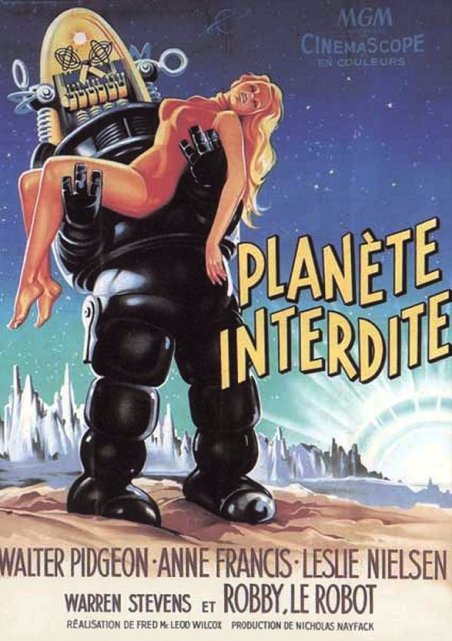
Robby is a friendly robot who first appeared in "Forbidden Planet" science-fiction movie from 1956. Though the film now seems to be a bit old-fashioned, it has its devoted fans in the world. Many of them collect original items or recently manufactured toys and gadgets connected with the movie.


I was actually born during the Communism. At that time we had rather simple toys and there was not much of a choice - just a couple of shapes and designs. One of them was a plastic earthworm made of 3 balls, one put on the top of the other, with two antennas sticking out of its head. It was usually in the colour of wrinkled leaves, super-cloudy sky, melted banana ice-creams and dead oranges. I guess there was also a violet version, but it was also dim, let's say it was in the shade of grape juice which you put in a glass, but forgot to drink and reminded yourself about after 2 years. I guess these toys and colours could have been the reason for my depressive childhood. The earthworm was made of very hard plastic. My mother was afraid I would pick out my eyes with the toy's antennas, so she cut them off. They should have used softer material to produce that toy. I had indifferent attitude towards the earthworm when I was a child. I rather used it for decoration in my room or in the castles which I used to build with my great-grandmother. I didn't really play with it. However, when I think of it now, I feel nostalgic.


Robby The Robot
actually reminds me of my Communist childhood earthworm toy. He brings a lot of positive feelings into my heart. Robby was also constructed out of several balls, one put on the top of another. His character was inspired by Ariel - a ghost, a forest spirit and a servant from one of Shakespeare's play. It is an interesting transition to me. A character who in the old drama came from the world of magic, in a new interpretation comes from the world of technology.


I have been wondering about this techy fetish in the contects of robots. As you can see it in vintage science-fiction movie posters, there are fainting women in the arms of robots which reminds me of King-Kong and Ann Darrow. Machines seem to have sexual feelings towards women, though it is obvious that a human is not an appropriate partner for a machine. What aspects of our subconsciousness robots represent? It seems that they represent male and animal energy which dominates women. However in old films robots are usually rather simple, they move in a bit awkward way, they don't harm humans and protect the female character. Robby was a faithful servant with an intelligence of a child or a dog. In the vintage photos "Forbidden Planet's" leading actress Anne Francis seems to flirt a bit with Robby. Perhaps this represents somewhat teenage fascination with women and female's desire to have a faithful friend and a slave? It is a bit risky to go deeper into that. Vintage robots/women photographs and posters are confusing, but at the same time intriguing.


Robby became a huge inspiration for a generation. Until 1970 he appeared in several movies and TV-series. After that he had few film roles. He is featured in 2006 commercial of an American telephone industry. He still moves people's hearts and imagination.

Saturday, 25 July 2009

Modern Culture Fantasies


Vintage science-fiction movie posters portray a very interesting tension between robots and women. It reminds me the most of a relation between the gigantic ape and a woman in "King-Kong". When I was a child I was very confused with the affection between the two characters. King-Kong was clearly in love with the woman. Though he was an animal, his love was pure and in a way "human". The beautiful girl was first horrified, but later also charmed with the monster. When I was very little I thought it was very beautiful, but I didn't understand how it would be possible for the sky-scraper-size ape and relatively tiny woman, who actually looked like a doll, to make love and... well.. have children? Little girls think of the world in a very simple way. I feel the same confusion in terms of robots vs women. I guess both of the fantasies - the animal and technology fantasy - represent a very similar psychological aspect of a humankind and our modern and popular culture.